Automation History
Automation History Illustrated Timeline Collection – Volume 1: Origins of Civilization (10,000 BCE–500 BCE)
Automation History Illustrated Timeline Collection – Volume 1: Origins of Civilization (10,000 BCE–500 BCE)
Couldn't load pickup availability
Automation History Illustrated Timeline Collection — Volume 1
Origins of Civilization: 10,000 BCE–500 BCE
Discover the Ancient Origins of Automation, Engineering, and Technology
Long before industrial automation, robotics, artificial intelligence, smart factories, and computers, humans were already developing organized systems designed to improve productivity, manage resources, reduce labor, and make work more predictable.
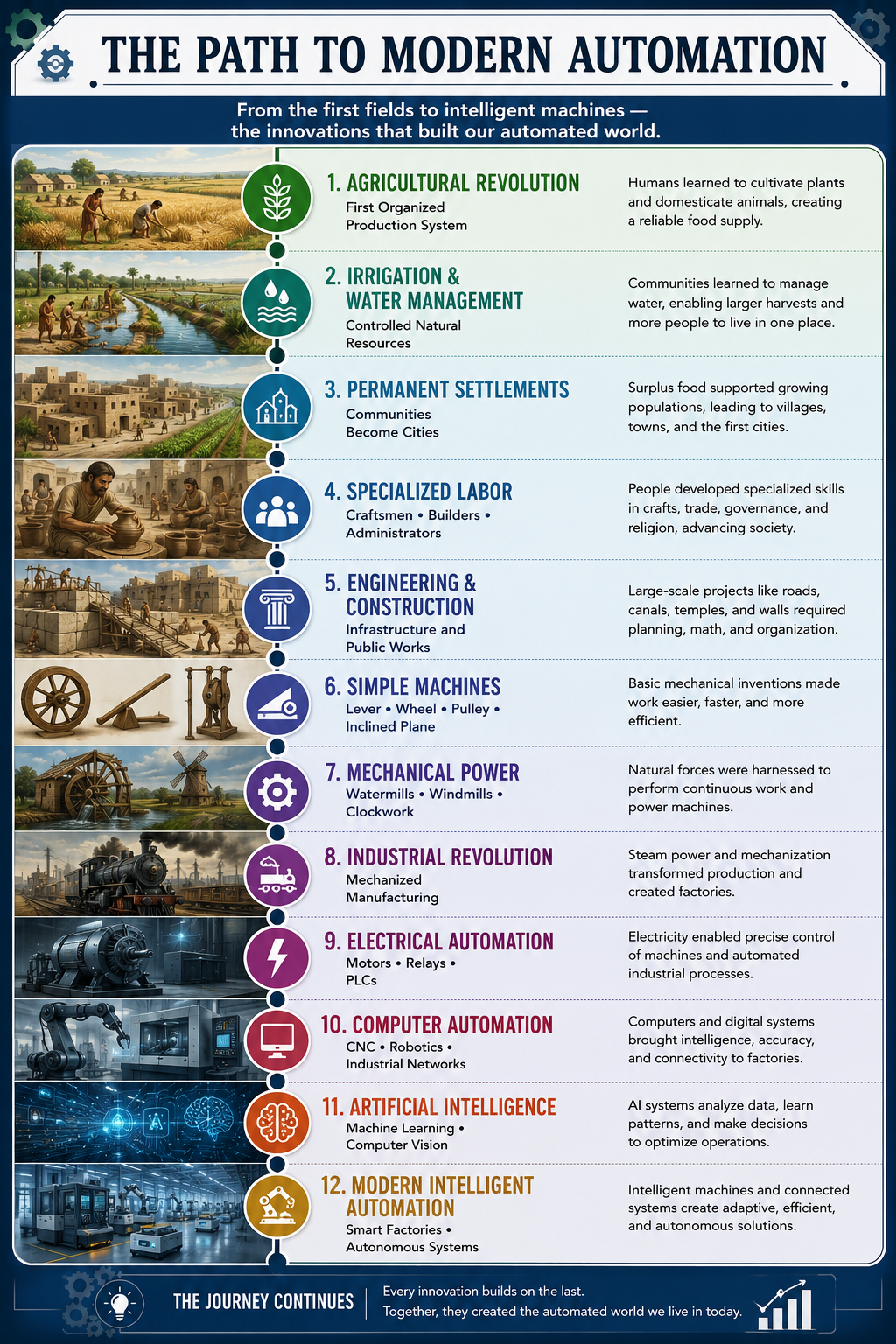
Automation History Illustrated Timeline Collection – Volume 1: Origins of Civilization (10,000 BCE–500 BCE) explores the earliest foundations of automation history, ancient engineering, agricultural technology, irrigation, manufacturing, process engineering, and technological innovation through historical explanations, illustrations, timelines, and connections to modern technology.
Beginning with the Agricultural Revolution, this illustrated history follows humanity's transformation from hunter-gatherer communities into permanent agricultural societies. Early civilizations learned to organize crop production, manage water, store resources, coordinate labor, and develop increasingly sophisticated tools and infrastructure.
The development of ancient agriculture and irrigation systems was especially important. Farming introduced repeatable production processes, while irrigation allowed communities to control the collection, movement, storage, and distribution of water. These technologies helped establish principles of resource management, process control, standardized work, systems thinking, and engineering that remain important in modern industry.
Follow the evolution of early technology as simple tools became more specialized, communities became more organized, and engineering projects became increasingly complex. Rather than treating ancient inventions as isolated discoveries, Volume 1 examines how innovations built upon earlier knowledge and created foundations for later mechanical engineering, manufacturing, industrial automation, robotics, and artificial intelligence.
The volume connects ancient civilizations and technology with modern engineering by examining the early development of repeatable production, organized workflows, resource and material management, process improvement, labor-saving technology, agricultural engineering, water management, and mechanical innovation.
Each section combines ancient history, engineering history, illustrated timelines, quick facts, educational diagrams, and scholarly references to explain what early societies developed, why those innovations mattered, and how their underlying principles continued to evolve.
Origins of Civilization is designed for readers interested in ancient history, ancient technology, engineering, inventions, archaeology, automation, manufacturing, robotics, STEM education, agricultural history, mechanical engineering, and the history of technology. It provides an accessible visual introduction for history enthusiasts, engineers, manufacturing professionals, educators, students, homeschool families, technology enthusiasts, and lifelong learners.
Automation History Illustrated Timeline Collection traces the larger history of automation and technological innovation, connecting humanity's earliest organized systems with the machines, factories, computers, robots, and intelligent technologies that followed.
Each volume explores another stage in this development, creating a connected timeline of the inventions, machines, engineering principles, civilizations, and technological breakthroughs that helped shape the modern world.
Before robotics came machines. Before machines came organized systems. And before modern automation came thousands of years of human innovation.
Begin the journey with Volume 1: Origins of Civilization — 10,000 BCE–500 BCE.