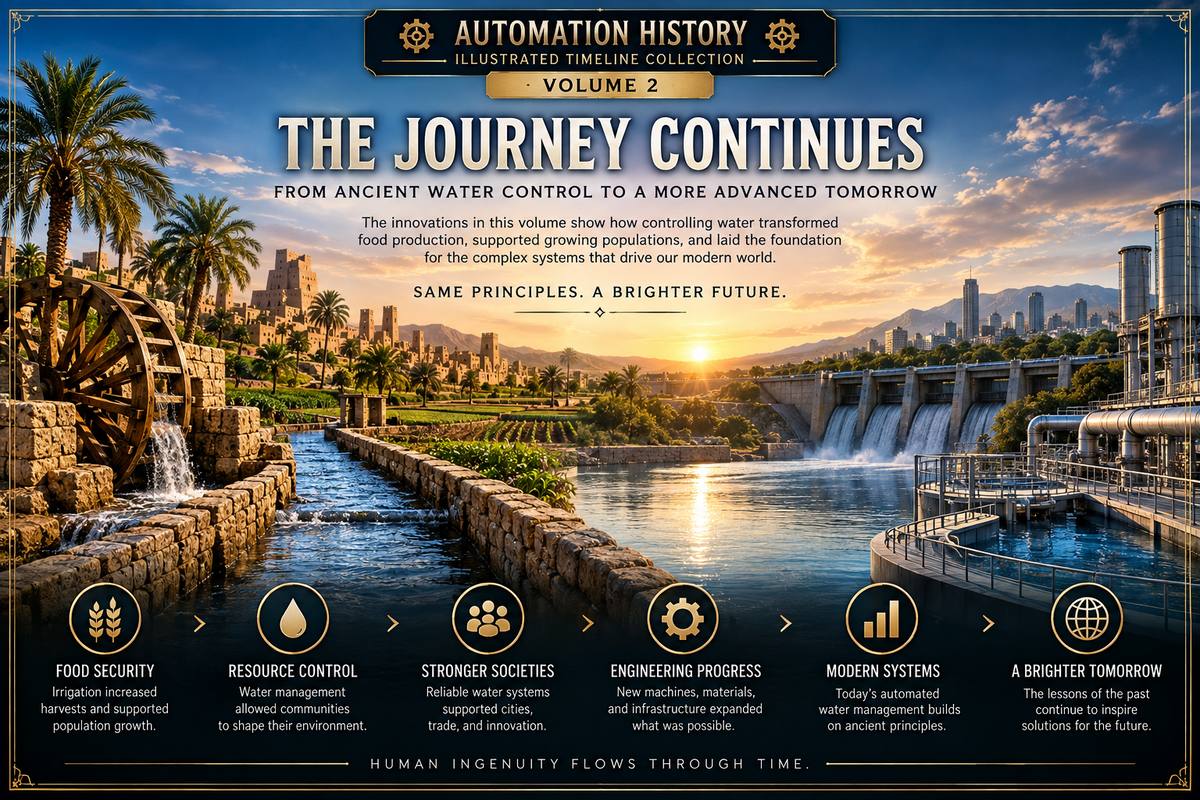
Automation History
Automation History Volume 2 Irrigation and Water Management
Automation History Volume 2 Irrigation and Water Management
Couldn't load pickup availability
Automation History Illustrated Timeline Collection — Volume 2
Irrigation & Water Management: Humanity Learns to Control Water
Ancient Irrigation, Hydraulic Engineering & the Origins of Process Control
How did ancient civilizations learn to manage water, protect crops, and build the infrastructure that sustained cities?
Volume 2: Irrigation & Water Management (10,000 BCE–500 BCE) explores early water engineering through scholarly historical research, visual timelines, illustrations, and connections to modern automated systems.
Trace the development of irrigation canals, river management, reservoirs and dams, water wheels, pumps, flood-control methods, and water measurement. Discover how ancient communities organized water collection, movement, storage, distribution and maintenance, laying foundations for hydraulic engineering and modern process control.
Inside Volume 2
- Historical background on early irrigation and river civilizations
- How gravity-fed canals, gates, branches and field basins worked
- The role of reservoirs, water lifting and flood management
- How irrigation supported agriculture, cities and organized societies
- Connections to sensors, pumps, valves, PLCs and automated irrigation
- A full-color illustrated timeline, quick facts, closing illustration and scholarly bibliography
For readers interested in: ancient history, engineering, agriculture, hydraulic systems, automation, archaeology, manufacturing, STEM education and the history of technology.
Digital Download
Format: Illustrated PDF
Pages: 10
Series: Automation History Illustrated Timeline Collection, Volume 2
Historical focus: Early irrigation and water management from approximately 10,000 BCE–500 BCE, plus connections to modern technology.
Digital publication only. No physical item is shipped. Your PDF will be delivered digitally after checkout once download delivery is configured.
Continue the illustrated journey from the earliest organized systems to the automation technologies that shape our world today.